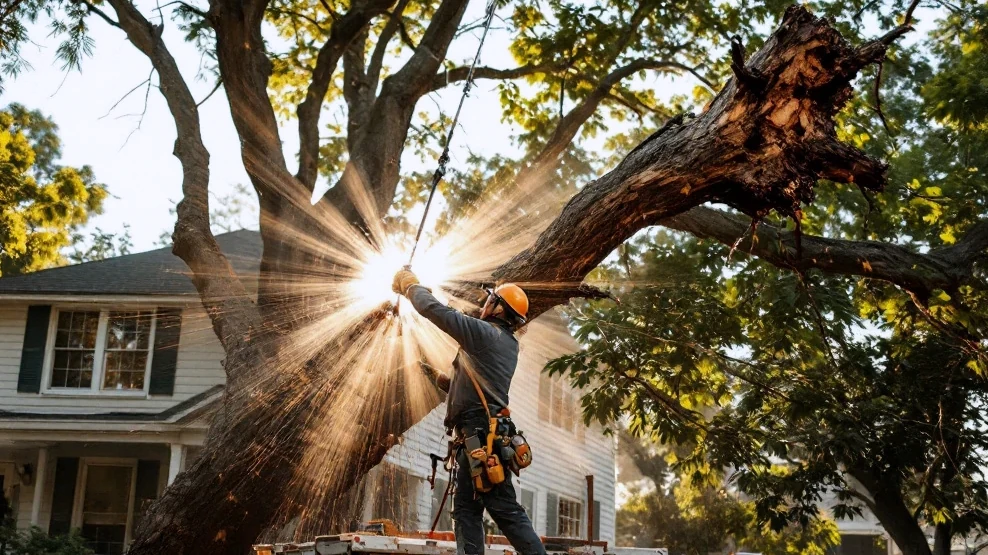
What is Large Tree Limb Removal and how does it work?
Large tree limb removal means cutting and lowering heavy branches, usually 15 feet or higher, that you can't safely reach with a ladder. We use a bucket truck, ropes, and rigging to bring each piece down without hitting your house, fence, or power lines.
A limb that's bigger around than your arm and hangs over your roof is not a do-it-yourself job. At that size, a branch can weigh hundreds of pounds, and if it breaks wrong, it can punch through shingles, take out a gutter, or land on someone. That's why these jobs typically require a bucket truck to work on trees 15 to 20 feet tall or more. (homeguide.com)
The work starts with a careful look at the tree, the limb, and everything underneath it. We check for cracks, rot, or lean, then figure out the safest way to cut. The goal is to lower each section on a rope so nothing free-falls. That protects your yard, your house, and our crew.
We cut in small pieces, not one big swing. A limb that's 30 feet long comes down in 3 to 5 foot sections, each one roped and lowered to the ground. Then we feed the branches into a chipper and haul off the wood unless you want to keep it for firewood.
Short version
- Large limbs are 15 feet or higher and too heavy for a ladder.
- A bucket truck and rigging let us lower each piece safely.
- Costs run $150 to $850, depending on limb size and access.
- We clean up all debris and leave your yard tidy.
How Large Tree Limb Removal Works, Start to Finish
We start with a free on-site look, then set up the truck, remove the limb in sections, and clean up every branch and chip. The whole job usually takes a few hours, but big or hard-to-reach limbs can take a full day.
First, we walk the property with you. We look at the tree's health, the limb's size, and how close it is to your house, garage, or power lines. We also check yard access. A wide open yard lets us drive the bucket truck right up to the tree. A narrow side gate means we might have to work from farther away or use ropes instead, which adds time.
Next, we set up the truck and get the rigging ready. The bucket truck lifts one of our crew members up to the limb. From there, we tie a rope around the branch and attach it to a lowering device. This lets us control the descent, so the limb doesn't swing into your window or drop onto your flower bed.
Then comes the cutting. We make a notch cut on the underside of the limb, then a back cut from the top. That guides the limb to fall in the direction we want. As we cut, the rope team on the ground pays out line, lowering each section gently. We repeat this until the whole limb is down.
Finally, we clean up. The branches go through a chipper, and we rake up the small debris. We load the wood into our truck unless you ask us to leave it. Most jobs include hauling everything away, so you're not left with a pile of brush in the backyard.
Larger limbs, or those tangled in other branches, might need a crane or a different approach. We'll talk you through that during the quote. But for most residential jobs, a bucket truck and a good rope crew get it done.
- Walk the site.We check limb size, tree health, and what's below the branch, like your roof or a playset.
- Set up the truck.The bucket truck positions our climber right at the cut point, no ladder needed.
- Rig the limb.A rope is tied high on the branch and run through a lowering device to control the drop.
- Cut in sections.We remove the limb starting at the tip and working back toward the trunk.
- Clean up.Branches are chipped, wood is hauled off, and we rake the area before we leave.
Why Large Tree Limb Removal Matters for Your Home
A large limb that hangs over your roof is a risk every storm season. It can scrape shingles, drop leaves in your gutters, or come down on your house in high winds. Removing it before it fails saves you from costly repairs.
Huntsville gets its share of thunderstorms and the occasional tornado warning. When a big limb breaks in a storm, it often lands on the very thing it hangs over: your roof. A branch that size can easily do thousands of dollars in damage, not to mention the danger if someone is outside.
Even when the weather is calm, an overhanging limb rubs against shingles with every breeze. That wears away the protective granules and shortens your roof's life. It also drops leaves and twigs into your gutters, which can cause water to back up under the eaves.
There's also the matter of tree health. A limb that's dead, cracked, or diseased is a weak point. Removing it early stops decay from spreading into the trunk. That can save the whole tree, which is worth more to your property than the cost of the removal.
Finally, there's liability. If a limb from your tree falls on a neighbor's house or car, you could be on the hook. Regular trimming keeps your trees safe and reduces the chance of a dispute. It's one of those things you do so you never have to deal with the aftermath.
Minor overhang
A limb that just touches your roof in high wind. Watch for worn shingles or gutter buildup.
Dead or cracked limb
If you see bare branches in summer or a visible crack, plan removal within a few weeks.
Leaning or split limb
A limb that's already pulled away from the trunk is an emergency. Call us right away.
Common Problems and What Causes Them
Most large limb problems come from storm damage, disease, or poor structure. A limb might split at a weak fork, rot from the inside, or get too heavy for its attachment point. Catching these early keeps the damage small.
One of the most common issues we see is a limb that's grown too long and heavy for its base. The tree might have a V-shaped fork where two branches meet, and that joint is inherently weak. Over time, the weight of the limb stresses the fork, and a storm or even a heavy wind can split it right down the middle.
Another frequent problem is decay. A wound from a past storm or a bad pruning cut can let fungi in. The inside of the limb rots while the outside still looks fine. You might not notice until the limb breaks. That's why we look for mushrooms at the base or soft spots on the bark.
Storm damage itself is a big one. Huntsville's summer storms can snap limbs or twist them, leaving cracks that don't show up right away. A limb might look fine for months, then fail during the next storm. After a severe storm, it's worth having a professional check your trees.
Then there's the simple issue of overgrowth. A limb that rubs against your house or another tree will eventually wear through. It can also block sunlight and airflow, which stresses the tree and makes it more susceptible to pests. Regular trimming keeps the tree's shape balanced and reduces the chance of a break.
Finally, some problems come from the tree's own structure. Some species, like water oaks, are prone to weak forks. Others, like pines, can drop limbs in high winds. Knowing what kind of tree you have helps us predict what might go wrong.
A limb that breaks in a storm is the expensive way to learn you needed a trim.
Frequently Asked Questions
How much does large tree limb removal cost in Huntsville?
Large tree branch removal runs $150 to $850 on average, but the final number depends on the tree type, limb size, and yard accessibility. (homeguide.com) For a limb that's high up or hard to reach, the cost often lands toward the upper end. The only way to know for sure is a free on-site quote.
Can I remove a large limb myself with a chainsaw?
A limb that's 15 feet or higher is not a safe DIY job. You'd need a ladder, which puts you at risk of a fall, and cutting a heavy limb wrong can make it swing into you or your house. We use a bucket truck and ropes to control every cut, which is why these jobs cost what they do. (homeguide.com)
How long does it take to remove a large limb?
Most single-limb removals take a few hours, including setup and cleanup. If the limb is very large, or if access is tight, it can take most of a day. We'll give you a time estimate when we quote the job.
Do you need to use a bucket truck for every large limb?
Not always. If the limb is reachable from the ground with a pole saw, we might not need a truck. But for anything 15 to 20 feet up or higher, a bucket truck is the standard tool. (homeguide.com) It's safer and faster than climbing with a ladder.
Will you remove the wood and branches after cutting?
Yes, our standard service includes chipping the branches and hauling away the wood. If you want to keep the wood for firewood, just tell us and we'll leave it in manageable rounds. We also rake up the small debris before we leave.
What if the limb is close to power lines?
We don't work within 10 feet of live power lines. If a limb is that close, you'll need to contact Huntsville Utilities to have the line de-energized or trimmed by their crew first. Once the line is safe, we can handle the rest of the tree.
How do I know if a limb is dead or just dormant?
In winter, it can be hard to tell. Scratch the bark with your thumbnail: if it's green underneath, the branch is alive. If it's brown and dry, that section is dead. Dead limbs are more likely to break, so they should come down sooner rather than later.
Do you offer stump removal after cutting a limb?
We focus on limb removal, but if you need a whole tree taken down and the stump ground out, we can do that too. Stump removal in Huntsville averages around $147, though it can run higher for large stumps. (todayshomeowner.com)
What causes a limb to split at the fork?
A V-shaped fork is inherently weaker than a U-shaped one. As the limb grows, the weight increases, and wind puts stress on the joint. Over time, the bark can get included, meaning it grows inward and creates a weak seam. That's a common reason limbs fail in storms.
How often should I have large limbs inspected?
After any severe storm, and at least once a year, it's smart to have a professional look at your trees. We can spot early signs of decay or weakness that you might miss from the ground. Catching a problem early is far cheaper than dealing with a fallen limb.
Sources
Need tree trimming in Huntsville? Get a free estimate today.
📞 256-581-8736