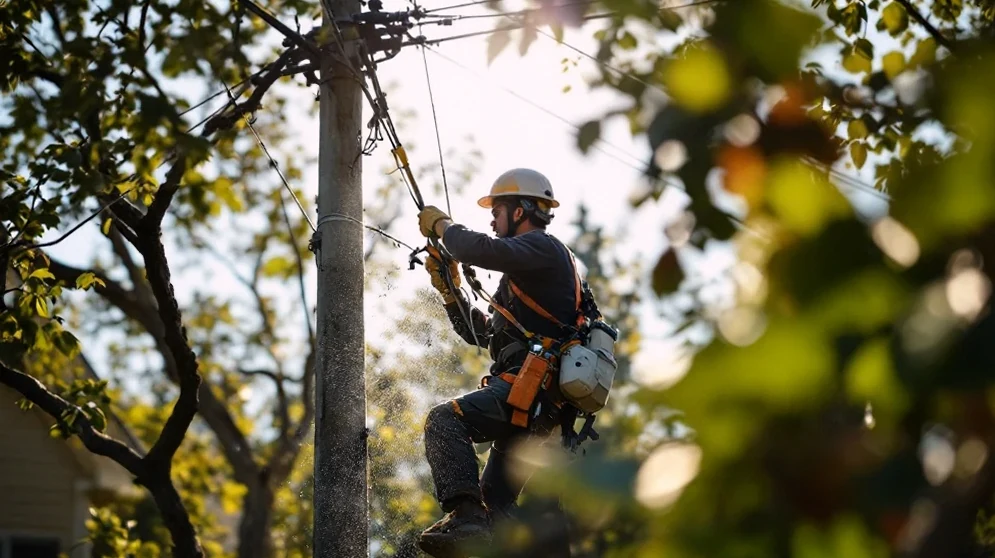
What is Power Line Clearance Trimming and how does it work?
Power line clearance trimming is cutting back tree limbs that grow into the utility easement, the strip of land the power company keeps clear so lines stay safe. In Huntsville, Huntsville Utilities runs a free program for trimming near its lines, and its Line Clearance Department handles that work. (hsvtreepros.com) (hsvutil.org)
The key distinction is who owns the problem. If a limb is touching or close to an energized line, the utility controls that cut. If the limb is on your side of the easement and just hanging over your driveway, that's a private trim you'd hire out. Most homeowners in neighborhoods like Five Points, Blossomwood, and the older streets off Whitesburg don't know where that line falls until they call.
Clearance trimming isn't the same as pruning for looks. The goal is a specific gap between the branch and the conductor, and that gap has to survive wind, ice, and a few years of growth. A crew cutting for clearance will often take more off one side of a tree than a homeowner expects, because the branch has to stay out of the line through the next growing season, not just today.
That's why the work looks aggressive. A red oak that's been limbed up over a driveway for years can suddenly get a hard cut on the line side. It's not vandalism. It's the minimum distance the utility needs to keep the line from arcing or the limb from breaking and taking the line down.
- Utility side of the easement: Huntsville Utilities trims it, at no charge to you. (hsvtreepros.com)
- Your side of the easement: you hire the trim, and you control how the tree looks afterward.
- Any work within the clearance zone: only line clearance qualified personnel should do it. (alabamapower.com)
Short version
- Huntsville Utilities trims trees near its power lines for free. (hsvtreepros.com)
- You call 256-535-1224 to start that request. (hsvutil.org)
- Anything on your side of the easement is a private job, and we handle those.
- Never let a general trim crew work within reach of a live conductor. (alabamapower.com)
How Power Line Clearance Trimming works, start to finish
It starts with a request or a utility inspection, then a qualified crew assesses the span, cuts to a set clearance distance, and chips or hauls the debris. On the private side, we walk the property, mark what's yours versus the utility's, and trim to keep limbs off the line without wrecking the tree's shape.
On the utility side, the process is driven by a route. Huntsville Utilities Line Clearance Department works through circuits on a cycle, and when they reach your street they trim everything inside the easement whether you asked or not. (hsvutil.org) If you've got a limb that's grown into the line ahead of that cycle, you can call 256-535-1224 and ask them to come out sooner. (hsvutil.org)
When a crew shows up, the first thing they do is identify the conductors and the voltage. A service drop to your house is a different animal from a primary line running down the pole. The clearance distance, the tools, and the crew size all change with that. A limb near a 7,200-volt primary gets treated with a lot more respect than a branch brushing a 240-volt service line.
Cutting happens in a specific order. The crew works from the line outward, taking weight off in small pieces so nothing swings into the conductor. On a big hardwood, that means rigging: ropes, a friction device, and a ground person controlling the fall. You'll hear a chainsaw, then a pause, then a crack, then the chipper. That pause is the ground guy setting the rope.
Debris handling is where the two sides differ most. Utility crews typically chip what they cut and leave the chips or haul them, depending on the contract. On private jobs, we ask up front whether you want the wood. A big oak trunk section is worth keeping for firewood, and most homeowners want it. The brush goes through the chipper and out.
After the cut, we look at the tree, not just the line. A limb that was crowding the wire usually means the tree was planted too close or has been leaning for years. We'll tell you if the tree needs a second trim in two years or if it's a removal candidate, because cutting the same limb every season gets expensive.
- Identify the line.Primary, secondary, or service drop. The clearance distance and the safety plan depend on which one you're near.
- Set the clearance.The crew marks how far back the limb has to come so it stays clear through wind and growth, not just today.
- Cut from the line out.Small pieces, rigged where needed, so nothing swings into the conductor or lands on your roof.
- Clear the debris.Chips out, wood left or hauled depending on what you asked for before the crew started.
- Check the tree.Look at whether the same limb will be back in the line next year, and plan the next cut or a removal.
Why Power Line Clearance Trimming matters for your home
A limb in the line can knock out power to your block, drop a live conductor in your yard, or start a fire when it contacts the wire. Clearance trimming prevents that, and it also keeps you from paying for a private trim you didn't need to pay for. (hsvtreepros.com)
The obvious cost is the outage. When a limb takes down a line on your street, you're out of power until a crew gets there, and in a storm that can be days. The less obvious cost is the one on your side of the meter. A limb that rubs a service drop can wear through the insulation over time, and that's an electrician's problem, not a tree problem, once it fails.
There's also the fire angle. A dry limb that contacts an energized conductor can arc and ignite. It doesn't take a big branch. A pencil-thick dead limb touching a primary in August is enough. That's why utilities trim on a cycle instead of waiting for a complaint.
For homeowners, the money angle is straightforward. Huntsville Utilities trims near its lines for free. (hsvtreepros.com) If you call us first for a limb that belongs to the utility, you could pay for work that was free. We'd rather tell you to call them and save the money. Tree trimming in Huntsville runs $400 or more for a medium tree, $800 or more for a large specimen, and $1,500 or more for a multi-tree property, so knowing which side of the easement you're on matters. (dixielandtree.com)
Limb within a few feet of the line
Not touching yet, but it will be after a growth season. Worth a call to the utility to get on the schedule.
Limb touching or rubbing the line
Stop trimming it yourself. Call Huntsville Utilities at 256-535-1224 and keep people and pets back. (hsvutil.org)
Branch down on the line or a conductor on the ground
Call the utility and 911. Treat every downed line as live, even if it looks dead. (hsvutil.org)
Common problems and what causes them
Most power line problems trace back to three things: the wrong tree planted in the wrong place, a homeowner trimming the utility side themselves, and a limb that was cut once and never followed up. Each one has a different fix.
Fast-growing species near a line are the number one repeat customer. A silver maple planted eight feet from a pole in 1995 is now a 40-foot tree leaning into the primary. Utilities can cut it back every cycle, but the tree keeps coming. The fix is usually removal and replanting with something that tops out under 25 feet, like a dogwood or a redbud.
Homeowner trimming is the one that gets people hurt. A pole saw and a ladder near a service drop is a bad combination, and it's the reason line clearance work is restricted to qualified personnel. (alabamapower.com) If you're not sure whether a limb is in the clearance zone, don't guess. Call the utility or call us and we'll tell you which side it's on.
The third pattern is the one-cut-and-done trim. A crew takes a limb off the line, the tree looks fine, and nobody looks at it again for five years. By then the tree has grown back into the line and the next cut is bigger. On a fast grower, a two-year follow-up is cheaper than a five-year one because you're taking less wood each time.
Poor pruning cuts cause their own problems. A stub left on a limb near a line will sprout a cluster of weak shoots that reach for the conductor. A proper cut at the branch collar heals over and doesn't send up that mess. That's a detail a lot of general trim crews miss on line work because they're cutting for clearance, not for the tree.
- Tree too close to the pole: removal and replant with a short species.
- Homeowner trimming near a live line: stop, and let qualified personnel handle it. (alabamapower.com)
- One-time trim with no follow-up: schedule the next cut before the limb is back in the line.
- Stub cuts near a conductor: they sprout weak growth that heads straight for the wire.
Call the utility when
- A limb touching or close to the power line.
- A branch is down on the line or a conductor is on the ground.
- That tree sits inside the easement, and you want it trimmed for free. (hsvtreepros.com)
Call us when
- Your limb sits on your side of the easement and over your roof or driveway.
- Tree needs shaping, deadwood removal, or a removal.
- You want the wood kept and the brush hauled off.
- Utility crews cut it back hard and you want the tree cleaned up.
What to do before you call anyone
Stand back and look at where the limb is relative to the wire. If it's touching or within a few feet of the line, call Huntsville Utilities at 256-535-1224 first. If it's clear of the line but over your property, that's a private trim and we can quote it.
You don't need to climb anything or get a ladder out. Look from the ground, from the street, and from a second-story window if you have one. The view from above tells you more about how close the limb is than looking up from the driveway.
Have a few things ready when you call. Your address, the nearest cross street, and which pole the tree is near. If you can tell whether the line is the one running to your house or the one running down the street, that helps. The service drop to your meter is lower and thinner than the primary, and it's usually the one homeowners can safely have trimmed by a private crew with the right training.
Huntsville Utilities Administration Building is at 112 Spragins Street if you'd rather walk in, but the phone is faster for a trim request. (hsvutil.org) If you're not sure whether the work is theirs or ours, call us and we'll look at it. We do this every week and we can usually tell from a photo.
If the limb is touching the line, the next person to touch it should be line clearance qualified, and that's not a DIY job. (alabamapower.com)
What clearance trimming costs in Huntsville
Utility-side clearance trimming is free through Huntsville Utilities. (hsvtreepros.com) Private trimming on your side of the easement runs $400 or more for a medium tree, $800 or more for a large specimen, and $1,500 or more for a multi-tree property. (dixielandtree.com)
Those private numbers are starting points, not quotes. A medium tree with easy access and a clean drop zone sits near the low end. A large oak with a lean toward the house, a fence in the way, or a tight back gate pushes toward the high end. Multi-tree properties get priced as a package, and the per-tree cost usually drops because the crew is already set up.
Line clearance work on the private side can cost more than a standard trim because of the extra rigging. If a limb has to come down in pieces without hitting the line, a fence, or a roof, that's more time on the rope and more people on the ground. It's not a padded price. It's the difference between dropping a limb in an open yard and lowering it by hand.
The only way to get an exact number is an on-site look. Photos help, but we need to see the drop zone, the access, and how close the tree is to the line. We quote free, and we'll tell you straight if the work is the utility's job so you don't pay for something that's covered.
If the limb is in the utility easement, call Huntsville Utilities first at 256-535-1224. It's free. (hsvutil.org) If it's on your side, we quote it, and typical private trims start at $400 for a medium tree and go up from there. (dixielandtree.com)
Frequently Asked Questions
Does Huntsville Utilities trim trees near power lines for free?
Yes. Huntsville Utilities offers free tree trimming near power lines to its customers through its Line Clearance Department. (hsvtreepros.com) (hsvutil.org) The catch is that it only covers trees inside the utility easement. Anything on your side of that line is a private job.
Who do I call to get a tree trimmed near a power line in Huntsville?
Call Huntsville Utilities at 256-535-1224 and describe the location. (hsvutil.org) If the tree is on your property and clear of the line, call us and we'll quote the trim. When in doubt, call the utility first. It costs you nothing and it tells you which side of the easement you're on.
Can I trim a tree near a power line myself?
No. Only line clearance qualified personnel should perform tree work around or adjacent to power lines. (alabamapower.com) A pole saw and a ladder near an energized conductor is how people get killed. Even a limb that looks like it's clear can move into the line when you cut it.
How close can a tree be to a power line before it's a problem?
It depends on the voltage and the species, but a limb within a few feet of the conductor is worth a call. Fast growers like silver maple and willow can close that gap in a single season. If you can see daylight between the limb and the wire today, you've got time. If the limb is touching, stop and call the utility.
What happens if a tree limb falls on a power line?
Call Huntsville Utilities and 911. Treat every downed line as live, even if it looks dead, and keep people and pets well back. (hsvutil.org) Don't try to move the limb or the line. The utility has to de-energize the circuit before anyone touches it.
Will the utility trim my tree the way I want it trimmed?
No. Utility crews trim for clearance, not for looks. They'll take the limb back to whatever distance keeps it out of the line through the next growth cycle, and that can leave a tree looking lopsided. If you want the tree shaped or cleaned up afterward, that's a private trim, and we do those all the time after a utility cut.
How much does private tree trimming cost in Huntsville?
Tree trimming in Huntsville costs $400 or more for a medium tree, $800 or more for a large specimen, and $1,500 or more for a multi-tree property. (dixielandtree.com) Those are starting points. Access, rigging, and how close the tree is to the line all move the number. An on-site quote is the only way to get an exact figure.
Do I need a permit to trim a tree near a power line?
For utility-side work, the utility handles its own process. For private trimming, Huntsville doesn't require a tree permit for routine pruning on your own property in most cases, but some neighborhoods with historic overlays have their own rules. We check that before we start, and we'll tell you if your street needs anything extra.
How often does Huntsville Utilities trim trees on its lines?
Utilities trim on a cycle, working through circuits over a period of years rather than hitting every street every season. (hsvutil.org) If a limb has grown into the line ahead of your street's cycle, you can call 256-535-1224 and ask them to come out sooner. (hsvutil.org)
Can you trim a tree that's touching the power line?
If the limb is inside the utility easement and touching an energized line, that's the utility's work, not ours. Only line clearance qualified personnel should be in that zone. (alabamapower.com) We handle the limbs on your side of the easement, and we'll tell you when a job needs to go to Huntsville Utilities instead.
Sources
Need tree trimming in Huntsville? Get a free estimate today.
📞 256-581-8736