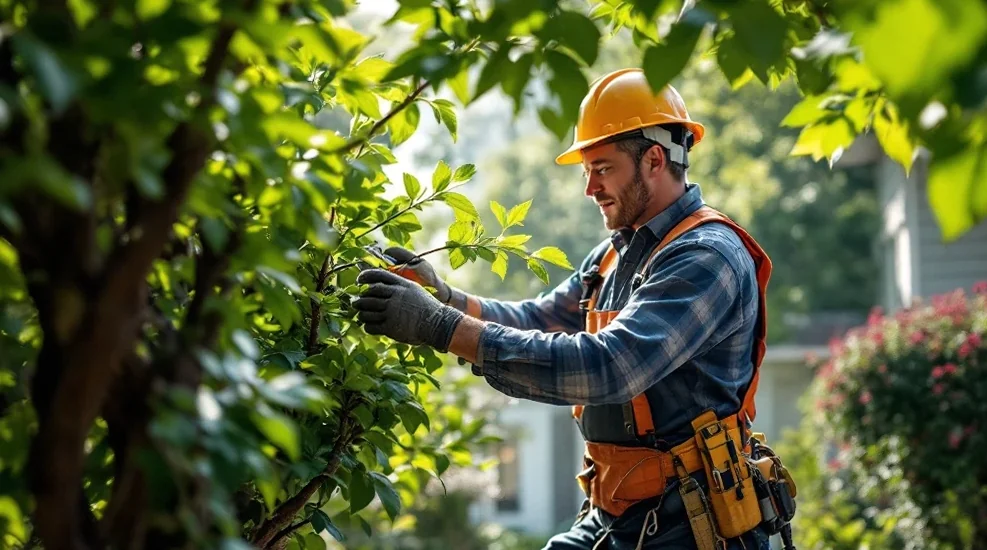
What is View Enhancement Pruning and how does it work?
View enhancement pruning removes specific branches to open a sightline, usually toward a ridge, valley, or the Tennessee River, without stripping the tree. We thin the interior, lift the crown, and make small reduction cuts where needed. The goal is a window you can see through, not a tree cut down to a stub.
Most pruning is about the tree: removing deadwood, clearing a roof, balancing weight. View enhancement pruning starts from the other direction. You point at what you want to see, and we work backward through the canopy to open that line of sight. On a lot off Green Mountain or up on Monte Sano, that might mean the ridge across the valley. Down near the river in Triana, it might mean water. In a Jones Valley backyard, it might be a neighbor's field or a distant cell tower you'd rather not stare at.
The work itself is a mix of three cut types. Thinning takes out selected branches through the middle of the canopy so more light and line of sight pass through. Crown lifting removes the lower limbs so you can see under the tree. Reduction cuts shorten a branch back to a side limb, which keeps the tree's shape while pulling weight away from wherever the view opens. We rarely do all three on the same tree. Which ones we use depends on species, age, and how much view you're trying to recover.
A common mistake is thinking this means cutting the tree way back or topping it. Topping is the one thing that will wreck the view long term, because the tree responds by throwing up a dense broom of fast, weakly attached shoots right at the height you cut. Two seasons later, the view is worse than when you started, and the tree is uglier and more dangerous. View enhancement pruning is the opposite approach: fewer cuts, placed where they matter.
- Thinning: removes selected interior branches to open light and sightlines.
- Crown lifting: takes lower limbs so you can see under the canopy.
- Reduction cuts: shorten a limb back to a side branch to move weight and open a window.
- No topping, ever. It creates a dense regrowth that closes the view and weakens the tree.
View enhancement pruning is selective branch removal aimed at a sightline, not a haircut. Done right, it opens the view and leaves a tree that still looks like a tree. Done wrong, it's topping with a nicer name, and the view closes back up in two years.
How View Enhancement Pruning works, start to finish
We start by standing where you want the view from, usually a deck, a kitchen window, or a porch chair, and sighting through the canopy. That tells us which limbs are in the way. Then we climb or use a lift, make the cuts, and chip the debris. Most residential jobs take a few hours to a day.
The first step happens before any saw starts. We walk the property with you and ask where you sit, where you look, and what you're trying to see. A view from a second-story deck is a different set of cuts than a view from a ground-level patio, even on the same tree. Getting this wrong is the most common reason a homeowner is disappointed: the crew prunes for the tree's health, the view doesn't open, and everyone's frustrated.
Once we know the sightline, we mark the limbs. On a big hardwood like an oak or hickory, that might be four or five well-placed cuts. On a dense pine or a cedar that's grown up in front of everything, it might be more, because those species hold foliage all the way to the ground and block a view completely. We're looking for branches that cross the sightline, plus any dead, broken, or rubbing limbs we can take while we're up there.
Climbing versus a bucket truck depends on access and height. A lift is faster and safer on a tree with a clear drop zone, but a lot of Huntsville lots have fences, power drops, or a slope that won't take a truck. In those cases we climb. Either way, the cuts are the same. We use a three-cut method on anything heavy so the branch doesn't tear bark off the trunk on the way down, and we rig limbs down over anything we don't want to hit, like a roof, a fence, or a prized shrub.
Cleanup is part of the job, not an afterthought. Everything we cut gets chipped and hauled. Some outfits blow the leaves off the lawn and leave the pile at the curb, which is fine until the city won't pick it up. We take it with us. If you want the chips for garden beds, say so and we'll leave them.
Timing matters for the view and the tree. Late winter, before bud break, is the cleanest window for most hardwoods in north Alabama, because the canopy is bare and you can see exactly what you're cutting. That said, you can prune a lot of species almost any time. The exceptions are the ones that bleed heavily in spring, like maples and birches, and oaks, which we avoid pruning in the warm months because of oak wilt risk. If your view is blocked by an oak, we'd rather do it in the dormant season than risk the tree.
- Walk the sightline.Stand where you look from. Mark the limbs crossing that line, not just the ones that look messy.
- Check species and season.Oaks wait for dormancy. Maples and birches avoid the spring bleed. Most everything else is flexible.
- Make the cuts.Thin the interior, lift the crown, and reduce limbs back to side branches. Three-cut method on anything heavy.
- Rig and lower.Anything over a roof, fence, or power drop gets roped down, not dropped.
- Chip and haul.Debris leaves with us. Chips stay only if you ask.
Why View Enhancement Pruning matters for your home
A view is often the reason someone bought the lot, and it's the one feature that grows shut on its own. Trees put on height and width every year, and a sightline that was open at closing can be gone in five or six seasons. Pruning on a schedule keeps the view you paid for without removing the trees that frame it.
Think about how fast a canopy closes. A young pine or sweetgum can put on two to three feet of height a year in good soil. A limb you can see under today is at eye level in a few years. Homeowners on the ridges around Huntsville, and on the slopes above the river, watch this happen year by year. The view that sold the house slowly fills in, and by the time it's gone, the trees are big enough that removing them is a major job.
View enhancement pruning is the middle path between doing nothing and clear-cutting. Doing nothing means the view disappears. Clear-cutting means you lose shade, privacy, windbreak, and the trees that make a lot worth living on. Selective pruning keeps the trees doing their jobs while opening the one thing you want to see. On a wooded lot, that's usually the difference between a yard you enjoy and a wall of green.
There's a practical side too. The same cuts that open a view often take weight off limbs leaning toward a house, clear branches off a roof, and remove deadwood that would come down in a storm. A limb that's blocking your mountain view is frequently a limb that's also hanging over your shingles. Handling both in one visit is cheaper than two separate calls, and it's better for the tree than getting hacked at twice.
Cost depends on the tree and the job. Tree trimming costs vary based on the size and complexity of the tree. (treeproshuntsville.com) A single tall pine with a clear drop zone is a different job than a multi-stem oak over a fence with a power drop in the way. For smaller work, hedge trimming and shrub pruning prices in Huntsville typically range from $39 to $64. (yourgreenpal.com) That range is for the small stuff. View work on mature trees runs higher because of height, access, and the skill it takes to make the right cuts instead of the easy ones.
One more thing worth saying: a view is a shared thing. If your sightline crosses a property line, you can only prune what's on your side. We can't cut a neighbor's tree without their say-so, and in Alabama that's a conversation, not a work order. If the view you want is blocked by a tree that isn't yours, the first step is talking to the neighbor, not calling a saw.
Worth it when
- You bought the place for that view, and now it's filling in.
- Limbs crossing the sightline are also over a roof or driveway.
- You want to keep the trees but see through them.
- You're willing to re-prune every few years to hold the line.
Hold off when
- That tree blocking the view isn't on your property.
- It's an oak and it's the middle of summer.
- This tree is already in decline and the cuts would finish it.
- You want the tree gone, not pruned. That's a removal, not view work.
Common problems and what causes them
Most view pruning problems come from three things: cutting too much, cutting the wrong limbs, and cutting at the wrong time of year. Topping is the worst offender. It closes the view back up within two seasons and leaves a weak, ugly tree. Over-thinning does similar damage in a different way.
Topping is the big one. Someone wants the view fast, so a crew cuts the top out of the tree. The tree panics and pushes a dense cluster of shoots right below the cut. Those shoots grow fast and upright, and they block the view worse than the original canopy. The tree also loses its natural form and becomes more likely to drop limbs later, because the new growth is weakly attached. We get called to fix topped trees all the time, and the fix is years of corrective pruning, not one visit.
Over-thinning is the quieter mistake. Take out too much interior growth and you get a tree that looks thin and spindly, with long limbs and a canopy that can't support itself. A tree needs a certain amount of leaf area to feed the roots and hold its structure. Prune past that line and you stress the tree, invite sunscald on suddenly exposed bark, and push it toward decline. The rule of thumb is not to remove more than about a quarter of the live canopy in one go, and less than that on older or stressed trees.
Wrong-season cuts cause their own problems. Prune an oak in the warm months and you risk oak wilt, a fungal disease that can kill a red oak in a single season. Prune a maple in early spring and it bleeds sap, which is messy and stresses the tree. Prune a flowering tree like a dogwood or redbud at the wrong time and you cut off next year's blooms. Matching the cut to the species and the calendar is a big part of doing this right.
Bad cuts are another source of trouble. A flush cut, where the branch is sliced off even with the trunk, removes the branch collar the tree uses to seal the wound. That leaves an open door for decay. A stub cut, where the branch is left too long, does the same thing from the other direction. The right cut is just outside the collar, angled so water runs off. It sounds fussy. It's the difference between a tree that heals and a tree that rots.
And then there's the view that keeps closing. If you prune once and never again, the same limbs grow back and the sightline fills in. View enhancement pruning is maintenance, not a one-time fix. On fast-growing species, expect to revisit every two to four years. On slower hardwoods, five to seven. The homeowners who keep their view are the ones who put it on a schedule, the same way they'd treat a roof or a gutters.
Finally, there's the property line issue. A view blocked by a neighbor's tree is a legal and social question, not a pruning one. In Alabama, you generally can't cut a tree that isn't yours without permission, and doing it anyway can land you in a dispute that costs far more than the view is worth. If the tree is on the line, the rules get murkier. Talk first. If it's your tree, we can help. If it's not, that's a conversation before it's a job.
Topped tree
Dense regrowth is already closing the view and the tree is structurally weak. Corrective pruning needs to start before the shoots harden off.
View half-closed
You can still see through it, but it's noticeably worse than last year. Prune this dormant season before it's gone.
Limbs over the roof
Not blocking the view yet, but they will be. Note them now and fold them into the next pruning visit.
What to expect when we're on your property
We walk the sightline with you, mark the cuts, and tell you what we can and can't do before we start. You get a free on-site quote because the only way to price view work is to see the tree, the access, and the drop zone. Then we schedule, prune, chip, and haul.
The quote visit is short but it matters. We look at the tree species, the height, the lean, what's under it, and how a truck or lift would get in. A tree with a clear lawn around it is a straightforward job. A tree wedged between a fence and a power drop, on a slope, with a shed under it, is not. That's why a phone estimate on view work is a guess, and guesses go wrong in both directions.
On the day, expect some noise and some sawdust. Chainsaws and chippers are loud. If you work from home or have a napping kid, tell us and we'll work around it where we can. We'll also let you know if a limb needs to come down over a bed or a walkway so you can move anything fragile first.
After the cuts, the tree will look thinner than it did. That's the point. Give it a season to fill in around the openings, and the view will hold for years before it needs another pass. If you're not happy with how it looks, tell us while we're still on site. Adjusting a cut is easy then. Coming back is not.
One thing we won't do is promise a view we can't deliver. If the tree blocking your sightline is on the neighbor's side, or if it's a species that won't tolerate the cuts, we'll say so. It's better to hear that on the quote than after the work.
What a view pruning visit includes
- Sightline walk with you before any cutting.
- Species and season check, including oak wilt timing.
- Selective thinning, crown lifting, and reduction cuts as needed.
- Rigging and lowering over roofs, fences, and drops.
- Chipping and hauling all debris off site.
Sources
Need tree trimming in Huntsville? Get a free estimate today.
📞 256-581-8736