How does Tree Trimming work?
Tree trimming is the selective removal of branches to improve the tree's health, shape, and safety. We assess the canopy, cut with precision, and clean up the debris before we leave.
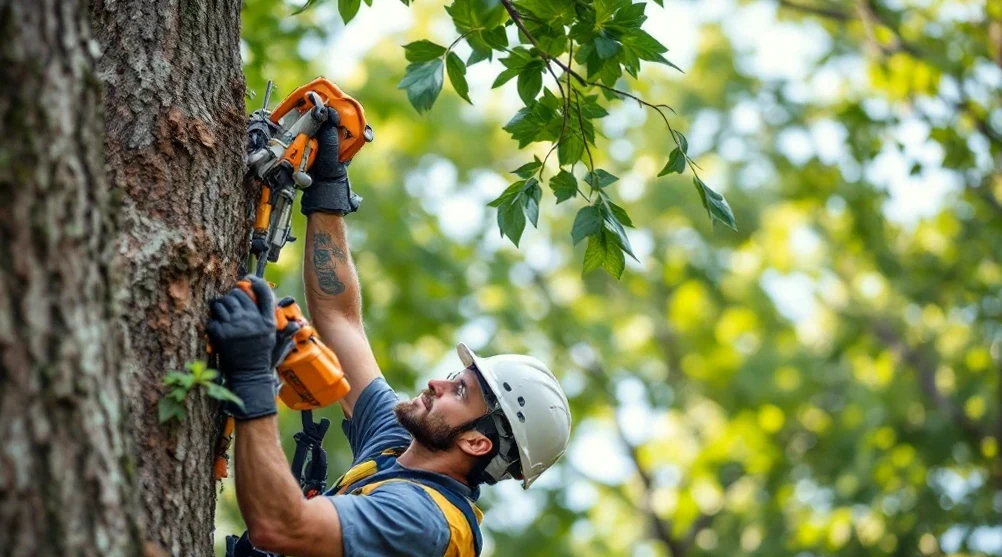
Tree trimming isn't just lopping off whatever looks long. It's a deliberate process. We start by walking the tree, looking at branch structure, dead wood, and any limbs that rub against each other or lean toward your house. Then we climb or use a lift to make cuts at the right spots, usually just outside the branch collar, the swollen area where a branch joins the trunk. Cut there and the tree seals the wound properly. Cut in the middle and you leave a stub that invites rot and insects.
In Huntsville, our trees take a beating from summer storms and the occasional ice event. That's why a big part of trimming is removing weak, cracked, or dead branches before they become projectiles. We also thin the canopy so wind passes through instead of pushing against a solid sail. A dense, unthinned oak can catch a lot of wind, and that's how whole limbs peel off in a thunderstorm.
Some homeowners ask why we don't just top the tree, meaning cutting the top off to reduce height. Topping is a hack that ruins a tree's structure and forces out weak, fast-growing shoots. We don't do it. Proper trimming works with the tree's natural form, not against it.
The work happens in phases. First the assessment, then the cutting, then the cleanup. Each step matters. You might see a crew member on the ground feeding branches into a chipper while another is up in the canopy making cuts. We coordinate so nothing falls on your fence, your flower bed, or your roof.
We also check for hazards like power lines. If a branch is touching or near a line, we don't touch it; we call the utility company. That's a non-negotiable safety rule. Same goes for anything that looks like it might be a protected species or a nesting site for birds. We work around those as needed.
- Inspect the tree for dead, diseased, or crossing branches.
- Make clean cuts just outside the branch collar.
- Thin the canopy to reduce wind resistance and improve light penetration.
- Remove all debris, including branches, leaves, and wood chips.
Short version
- Trimming is selective, not random cutting.
- We prioritize dead and hazardous branches first.
- Cleanup is part of the job, not an extra.
- A free on-site quote gives you an exact price.
What to expect, start to finish
From the first call to the final cleanup, a typical trim follows a clear sequence. Here's the play-by-play of what we do and what you should be ready for.
It starts with a phone call or a quote request. We ask about the tree's size, location, and any obvious issues. Then we schedule a time to come look. That's when we give you a number, not a guess. For a 3,558 square foot property in Huntsville, a trim was priced at $171, but that's on the low end. (lawnstarter.com) For a medium tree, expect $400 or more. (dixielandtree.com) A large specimen tree runs $800 or more, and a multi-tree property can go $1,500 or more. (dixielandtree.com) These are typical ranges; the only way to know for sure is a free on-site quote.
On the day of the job, we arrive with the right gear. That includes ropes, saws, a chipper, and possibly a bucket truck for tall trees. We lay down tarps or plywood to protect your lawn and any hardscape. We also mark off the drop zone, the area where branches will fall. You'll want to move cars, patio furniture, and anything fragile out of the way beforehand.
The cutting itself is where the skill shows. We work from the top down, removing smaller branches first, then larger ones. Every cut is deliberate. We don't just hack at random. We're looking at the tree's overall shape and health, making sure we leave a balanced canopy. For fruit trees, the goal is different than for shade trees, and we adjust accordingly.
Cleanup is a big part of the job. We rake up every twig, haul away the big stuff, and run smaller branches through the chipper. We also offer to leave the wood chips if you want them for mulch. If not, we haul those away too. Some outfits blow the leaves out and call it done. We don't. Your yard should look like we were never there, except for the healthier tree.
After we're done, we do a final walkthrough with you. We point out what we removed and why, and we answer any questions. If you notice something later, like a branch that looks off, call us. We'll come back and make it right.
- Free on-site quote before any work begins.
- We protect your property with tarps and careful planning.
- Cutting starts at the top and works down.
- Full cleanup included, including chip removal.
- Final walkthrough to make sure you're happy.
- Get a quote.We come out, inspect the tree, and give you a firm price. No surprises later.
- Prep the area.Move vehicles and furniture. We'll handle the rest with tarps and ropes.
- Watch the work.You don't have to, but you're welcome to. We're happy to explain what we're doing.
- Enjoy the cleanup.We rake, chip, and haul everything. You get a tidy yard and a healthier tree.
How long does Tree Trimming take?
A single medium tree usually takes 1 to 2 hours. Large trees or multiple trees can take half a day or more. The exact time depends on size, condition, and access.
Time is one of the first questions we get, and it's a fair one. You need to know if we'll be there for an hour or an afternoon. For a small tree, say a dogwood or a young maple, we can be in and out in about an hour. A medium tree, like a mature crepe myrtle or a 30-foot oak, takes 1 to 2 hours. A large specimen tree, think a 60-foot oak or hickory, can take 3 to 4 hours or more. And if you have a multi-tree property, plan on a full day.
What slows things down? A few things. First, the tree's condition. If it's full of dead wood, that takes extra time to remove safely. Second, access. If we have to haul branches by hand because your backyard is fenced or the driveway is narrow, that adds time. Third, the weather. We don't work in lightning or high winds, and that can push a job to the next day.
The type of trim also changes the time. A light thinning is quicker than a heavy reduction. If you want a formal shape, like a lollipop topiary, that's detail work and takes longer. We'll give you a time estimate when we quote the job, and we stick to it as closely as we can.
For a property in Huntsville, the cost often reflects the time. A trim that takes an hour might be on the lower end, like the $171 figure mentioned earlier. (lawnstarter.com) A medium tree that takes a couple of hours runs $400 or more. (dixielandtree.com) Large and multi-tree jobs, which take most of a day, land at $800 to $1,500 or more. (dixielandtree.com) These are typical ranges; the only way to get an exact figure is a free on-site quote.
One thing to keep in mind: we don't rush. A rushed trim is a bad trim. We'd rather take an extra 30 minutes to do it right than leave you with a tree that looks like it was attacked with a hedge trimmer. So when you ask how long, the answer is: as long as it takes to do it properly.
Small tree (under 20 feet)
About 1 hour. Quick trim, light cleanup.
Medium tree (20 to 40 feet)
1 to 2 hours. Includes thinning and deadwood removal.
Large tree (40 feet and up)
3 to 4 hours or more. May require a bucket truck and extra crew.
Multi-tree property
Half a day to a full day, depending on how many trees and their size.
Sources
Need tree trimming in Huntsville? Get a free estimate today.
📞 256-581-8736